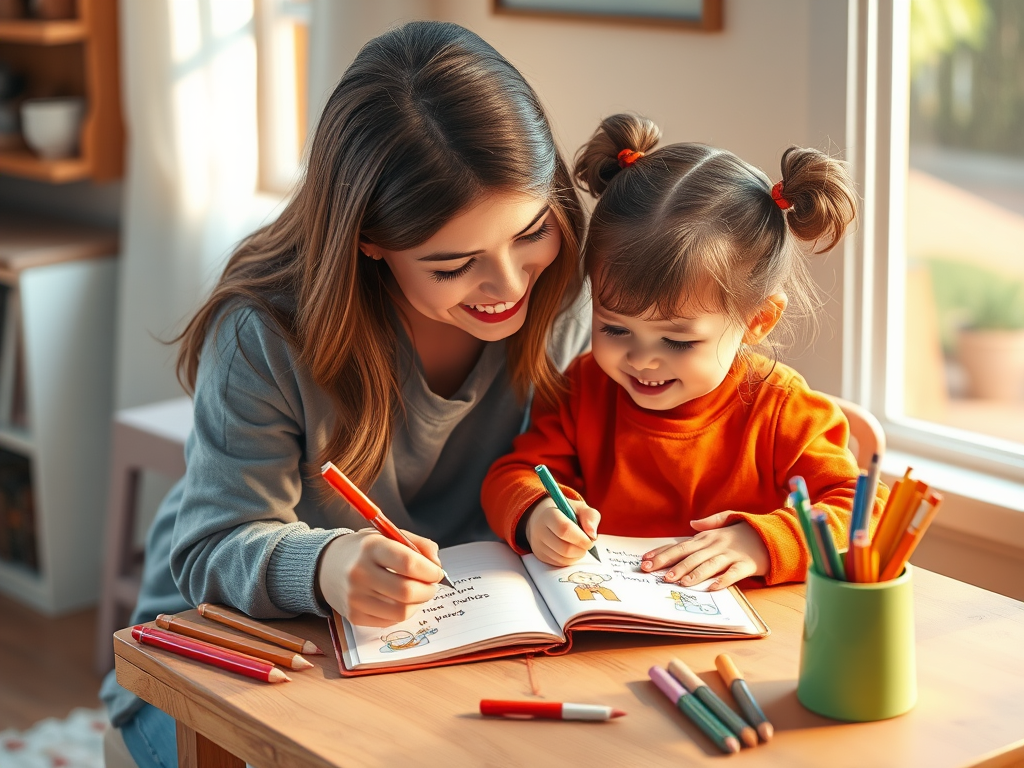
The other day, my daughter said “I like milk” and “I like socks.” It struck me—what a perfect place to start. These are simple “I like” statements she’s clearly mastered. So I got a journal where we could keep all her words in one place, and I wrote down the sentences she’d said and added some basic images and labels. Nothing fancy, just simple modeling of how her spoken words can become written words.

After our recent trip, I tried something similar. I wrote a few sentences capturing her trip highlights and added corresponding images—an airplane, things she’d seen and done. She lit up during the whole process as I read what I’d written and pointed to the images.
She’s still young, so I’m obviously not expecting her to write these herself yet. But the activity let me capture her ideas on paper, and we were able to engage together and recall our trip. Now we go back through the journal together, talking about the images and remembering what we did. She’s learning that what we write down stays—that we can return to it again and again.
This is writing instruction—even though she’s not holding a pencil. She’s learning that her spoken words can become written words, that her ideas are worth preserving, and that writing is a tool for remembering and sharing experiences.
The physical act of forming letters will come later, when her fine motor skills are ready. Right now, we’re building the most important foundation: she has something to say, and writing is how we save it.
What I’m realizing is that the skill of handwriting and fine motor development are separate from idea generation and the dialogue around ideas. Right now, I can easily transcribe her thoughts. As she begins to draw more, I can help add labels and words to her drawings. And as she starts forming simple letters and words herself, I can slowly write less and let her write more.
Eventually, you hope all these skills develop together—the physical ability to write, the capacity to generate ideas, and the confidence to express them. But they don’t have to develop simultaneously, and I think that’s important to remember.
For now, we’re just putting her words on paper. Simple statements like “I like milk” and memories of airplanes and adventures. She’s learning that her words matter. It’s a start.
Want more on early childhood development and learning? Check out our blog for practical ideas on supporting your little one’s growth. And if you missed how we’re building fine motor skills that will eventually support writing, check out Small Tools, Big Skills: A Toddler’s Fine Motor Journey.
Leave a Reply